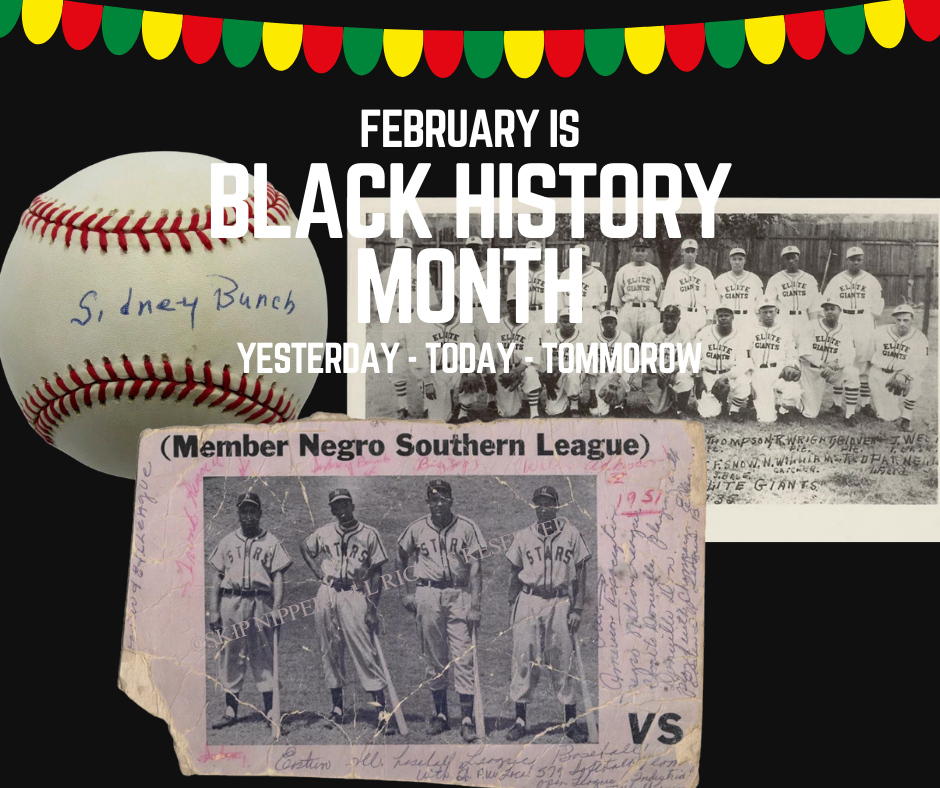
Celebrating Black History Month: Nashville, Tom Wilson and the Negro Southern League

Negro Leagues baseball celebrated its 100th anniversary in 2020 to connect the founding of the Negro National League (NNL) in 1920 in Kansas City. Rube Foster and other Black baseball team owners gathered to organize and carry out a vision of professional baseball that was often considered but never put into order.

That meeting took place on February 13, and eight franchises joined together: the Chicago American Giants, the Chicago Giants, the Cuban Stars Dayton Marcos, the Detroit Stars, the Indianapolis ABCs, the Kansas City Monarchs, and the St. Louis Giants.

The new enterprise experienced ups and downs, affected by lost revenues due to the Great Depression, inconsistency in franchise owners’ financial stability, and competition for players from a new league formed in 1923, the Eastern Colored League. The NNL collapsed in 1931.

One month after the NNL formed in 1920, Nashville’s Tom Wilson, owner of the Nashville Standard Giants, gathered southern Black baseball team owners in Atlanta to form the Negro Southern League (NSL). The new enterprise teams included the Montgomery Grey Sox, Atlanta Black Crackers, New Orleans Caulfield Ads, Knoxville Giants, Birmingham Black Barons, Nashville White Sox, Pensacola Giants, and Jacksonville Stars.
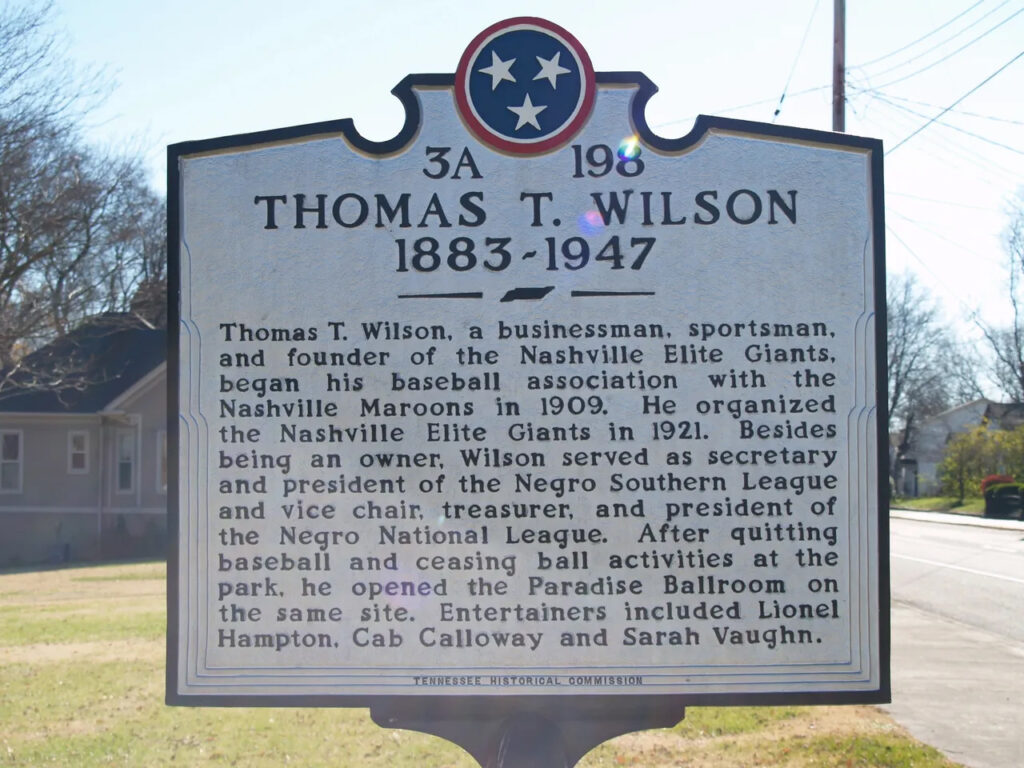
The NSL became the more financially stable league through 1936, although when the NNL reorganized in 1932, it was considered a minor league. The Nashville Elite Giants joined the new NNL, and when a new league, the Negro American League formed in 1937, the Birmingham Black Barons and Memphis Red Sox joined up, which led to the demise of the NSL. But not before a new Nashville team entered the NSL, the Black Vols.

When Jackie Robinson joined the Brooklyn Dodgers in 1947, the complete demise of Negro Leagues baseball was on the horizon. A new Negro Southern League had formed in 1945. It included the Nashville Black Vols under a new owner, Dr. R. B. Jackson, the Cubs beginning in 1946, and Stars (probably a combination of the Cubs and Stars), but by 1951, it, too, was consigned to oblivion.

The impact of Negro Leagues baseball in cities throught the United States was set in motion by the brave confidence of team owners, players, and fans. Nashville’s proud Black baseball history continues through this day with memories of Turkey Stearnes, Bruce Petway, Henry Kimbro, Butch McCord, Jim Zapp, Sidney Bunch, Jr., among others, leading the way.

Tom Wilson shares equally with Rube Foster in creating a lasting legacy for Negro Leagues baseball and its impact on baseball history in the United States!

Early Negro Southern League standings:

YearPennant Winner
1920Montgomery Grey Sox
1921Nashville Elite Giants
1922Nashville Elite Giants
1923Birmingham Black Barons
1924No Schedule Played
1925No Schedule Played
1926Birmingham Black Barons
1927Chattanooga Black Lookouts
1928No Schedule Played
1929Nashville Elite Giants
1930No Schedule Played
1931Nashville Elite Giants
1932Cole’s American Giants
1933Memphis Red Sox
1933New Orleans Crescent Stars
1934Incomplete
1935Claybrook Tigers
1936Birmingham Black Barons

Sources

Center for Negro League Baseball Research.

Heaphy, Leslie A. (2015). The Negro Leagues, 1869–1960. McFarland.

Holway, John (2001). The Complete Book of Baseball’s Negro Leagues: The Other Half of Baseball History. Fern Park, Florida: Hastings House Publishers.

Mills, P. (2003). “Negro League Baseball Dot Com – Historical Timeline Of Negro League Baseball”.

Negro Southern League Museum Research Center. Center for Negro League Baseball Research.

Plott, William J. (2015). The Negro Southern League, A Baseball History, 1920-1951, McFarland.

© 2025 by Skip Nipper. All Rights Reserved.
Comments Off on Celebrating Black History Month: Nashville, Tom Wilson and the Negro Southern League

Filed under Nashville Black Vols, Nashville Elite Giants, Nashville Stars, Negro Leagues

I Never Called Myself ‘Mr. Sulphur Dell’—Here’s the Story

I was reading one of Raymond Johnson’s columns in the Nashville Tennessean from 1949, where he stated that “at least a half dozen of the Nashville Vols go by their nicknames. 

These days, nicknames are not unusual, especially if you have an assumed name on one of your social media accounts. You get to be someone you are not, if you so choose, although I believe that is frowned upon and can be a little dangerous, can’t it? 

I digress because this came to my mind. When I was a kid, even today, on some of the reruns, my parents and grandparents love “The Carol Burnett Show.” One of the skits was when she said something like, “People call me by my nickname.” When one of the other actors asked, “What is it?”, she replied, “Nick.” 

Maybe that’s not exactly how it went, but that’s how I remember it. 

I have had folks ask me how I came up with the handle, “Mr.  Sulphur Dell.” I didn’t give it to myself, but I’ll get to that in a bit. But first, let me go back to baseball nicknames. 

In his column, Johnson writes “Chief reason is that their parents christened them with names that do not sound athletic. Some of them were tagged by teammates, others by sports writers.”[1] 

He mentions Cleston Ray first. No one would have called him “Cleston.” C-l-e-s-t-o-n. It was not even listed that way on some of the rosters, but “Charlie Ray.” However, he was known as “Bama,” and I’ll bet you can guess why.  

Yes, he was born in Jemison, Alabama, in 1920. Jemison is between Calera and Clanton, just west of Interstate 65. 

Pitcher Pete Mallory was also from Alabama, and although his given name was German, he was, too referred to a “Arab,” as that was the city he was from. 

“Bobo” Holloman was from Georgia, but his nickname had nothing to do with where he was from. He had three seasons with Nashville, his best in 1949 when he was 17-10. Manager Larry Gilbert gave him the nickname “Bobo” because the pitcher reminded him of Bobo Newsom, who had a 22-year career in the majors but had three pretty good seasons with Chattanooga and Birmingham. 

We are often familiar with some of the great baseball names from days gone by: “Babe,” “Pee Wee,” “Big Six,” “Big Train,” “Hack,” “Dazzy” and “Dizzy,” “Kiki,” “Mule,” “Rube,” – well the list goes on. 

There are great names for ball clubs, too. Did you know the Dodgers’ name comes from when the team was in Brooklyn and was named “Trolley Dodgers?” Can you guess why? 

In 1921, there was some effort to change the name of the Nashville Volunteers, or Vols, a name associated with the team since sportswriter Grantland declared it. Folks could fill out a form printed in the newspaper and mail it in to Nashville Banner sportswriter J. L. Ray or Nashville Tennessean sports editor Blinkey Horn to run for eight days. Nashville’s manager, Hub Perdue, suggested the effort as he thought “Vols” had become a jinx. 

Names submitted were Capitols, Hermits, Old Hickories, Jacksononians, Limbers, Dells Boils, Ain’t-it-Hell-Club, Invincibles, Aces, Bearcats, Tigers, Wampus-Cats, Wizards, Rockies, Liniments, Jags, Hubs (I wonder if Hub Perdue submitted that one), Spokes, Cumberlands, Pioneers, Rebels, Confederates, Rabbits, Tigers, Gamecocks, Vamps, Hellcats, Knockouts, and Eagles. 

The list was honed down to five: “Bobcats,” “Bulldogs,” “Hornets,” “Vols,” and “Wildcats.” 

Thank goodness none of those won out, and the team continued as “Vols,” perhaps thanks to the fan who wrote in: “Call ‘em Vols, damn a change.”[2] 

Which brings me to answering a question someone asked one time: 

“Why do you call yourself “Mr. Sulphur Dell?” 

Well, I never have but let me explain. 

When my book, “Baseball in Nashville,” was first published, I was invited to be on “The Plus Side of Nashville,” a daytime show hosted by Tuwanda Coleman on NewsChannel 5+, to discuss local baseball history. 

I was told that if I would like to have a copy of the program, I should bring a VHS tape with me, and I could leave with the audio of the interview. 

Waiting in the wings for the first guest to wrap up during a commercial break, Tuwanda pointed to me and asked the young musician if she knew who I was. 

“Yes,” she replied, “that’s Mr. Sulphur Dell.” 

I had no idea who she was, floored that she knew something about me, but like Grantland Rice’s moniker of “Vols” placed on the Nashville baseball team in 1908, I took “Mr. Sulphur Dell” and ran with it. 

That’s my moniker on social media. I am proud of it, and am glad that there is some connection to me and the old ballpark. 

My efforts to research and report baseball history have reached a full circle when folks appreciate what I have written about. Most importantly, I hope each one has learned something new. 

That is the best tribute to “Mr. Sulphur Dell” I could ever hope for. By the way, you can follow me here:

https://www.facebook.com/mrsulphurdell

https://www.instagram.com/nashville_baseball

https://twitter.com/mrsulphurdell?lang=en

Listen to my weekly Nashville Baseball History podcast episodes here:

https://www.buzzsprout.com/1966141

Sources

Nashville Banner

Nashville Tennessean

Newschannel5.com

Newspapers.com

References

[1] Raymond Johnson, “One Man’s Opinion” column, Nashville Tennessean, March 10, 1949, 24. 

[2] J. L. Ray, “The Vols’ Name,” Nashville Banner, February 13, 1921, 13.

© 2025 by Skip Nipper. All Rights Reserved.

Comments Off on I Never Called Myself ‘Mr. Sulphur Dell’—Here’s the Story

Filed under Categories